|
| Exterior of the Oratory |
Having spent some time looking at the Catholic churches of the West End, Holborn and the City, I have decided to move to the other side of London, to Kensington, and consider what is perhaps the grandest of the London Catholic churches, the Church of the Immaculate Heart of Mary, better known as the Brompton (or correctly, London) Oratory. This very large and imposing building is located in the heart of the 'museum district' of South Kensington, and is, arguably, their equal in terms of the artistic treasures it contains (I would say it is superior, as these treasures are still being used for their intended purpose of Divine Worship and Devotion, rather than the slightly melancholy spectacle of liturgical artifacts sealed up in glass cases, never to be used again, such as we see in the neighbouring V&A Museum).
 |
| The Interior |
The London Oratory was founded in 1849 by a number of clergy who had initially joined the then recently-established Bimingham Oratory, founded by the Blessed John Henry Newman. Most notable among these was Fr. Frederick William Faber, noted hymn writer, preacher and spiritual writer, who became the first Provost of the London community. In keeping with the Oratorian principles laid down by St. Philip Neri which involved mission to urban areas, the first London Oratory was located in a former commercial premises near Charing Cross (its previous uses have been described as a whisky-store, gin shop an dance hall). In 1852, a new site was puchased on what was then the edge of the city, in a small village called Brompton, near Kensington. A house and temporary church were built, and an appeal was started to fund a permanent structure.
 |
| Fr. Faber |
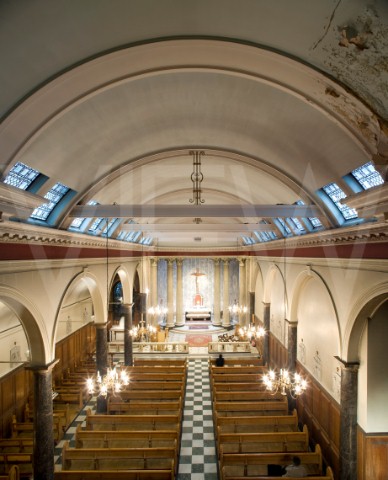
The present church was designed by Herbert Gribble, and was the largest Catholic church in London until the building of Westminster Cathedral in 1903. The cupola stands some 200 feet in height.
 |
| The Sanctuary, during celebrations for Newman's Beatification |
Perhaps the greatest stroke of genius was to build in a Baroque style at the height of the Gothic Revival in architecture. At this time, many churches on the continent (particulary in Italy) were being rebuilt or re-ordered in the prevailing fashion, and many Baroque altars and other features were being ripped out and sold at knock-down prices. The Oratorians took advantage of this market in 'architectural salvage', and this has resulted in many of the fine elements installed in the church.
 |
The Lady Altar
(former High Altar remove from an Italian church) |
 |
| The new statue of St. Wilfred |
The tradtion of installing fine artwork in the Oratory contiues to this day, with recent developments being the new chapel of Blessed John Henry Newman, a new Calvary statue, and a new statue of St.Wilfred for the chapel dedicated to him.
 |
| The Calvary |
 |
The Newman Chapel
|
St. Wilfred's Chapel was, for many years, used by the late Monsignor Alfred Gilbey, the formidable fomer Chaplain of Cambridge Universiy, who celebrated Mass there in the
Usus Antiquior each morning.
 |
| Monsignor Gilbey |
The building to the left of the courtyard in front of the clergy house contains the Little Oratory, a chapel associated with a pious confraternity, the Brothers of the Little Oratory, laymen who work in association with the Fathers in a similar way to Oblates or Tertiaries.
 |
| Statue of Newman in his Cardinal's robes outside the Little Oratory |
 |
| Interior of the Little Oratory |
I tend to call in to the Oratory for a time of prayer and refection when I am in South Kensington, usually when I have been to one of the museums. One of the Oratorian Fathers, Fr. Patrick Doyle, is an old friend from university days, and I will also sometimes pay him a call, if he is in. Please pray for Fr. Doyle, as he is now suffering from severe problems with his eyesight, and is close to blindness.
 |
| Quarant'ore at the Oratory |
Please visit the
Oratory website, for lots more information than I can include in this, already quite long, post.
 |
| Altar of the English Martyrs in St.Wilfred's Chapel |
There are a number of rather good restaurants in the area, and I would suggest seeking out one for lunch if you ever attend a Sunday morning Mass at the Oratory (the 9 a.m. Mass in celebrated in the
Usus Antiquior, and the 11 am Mass is a Solemn Latin
Novus Ordo Mass, done very well - all the Masses are said
Ad Orientem, as the sanctuary has never been re-ordered). I am afraid I can't make any specifc recommendations, as the little Italian place I used to go to closed a number of years ago, but you are sure to find somewhere good.
 |
| Altar of St. Philip Neri |
Our Lady, conceived without sin, pray for us.
St. Philip Neri, pray for us.
Blessed John Henry Newman, pray for us.